

Recovery context
Peptide conversations often appear around repair, training load, and return-to-baseline routines.
Peptide education
What they are, why people are talking about them, and how to think about the category with more precision and less noise.
You have probably heard the word in a gym changing room, on a podcast, from a friend who tracks their sleep score, or from someone who has recently become very serious about recovery.
Peptides. It sounds technical. It sounds a little exclusive. It can also sound more complicated than it needs to.
Peptide basics
Your body already makes them. It uses them constantly. They are part of the quiet language that helps tissues, organs, hormones, and cells coordinate what needs to happen next.
If proteins are long, fully built structures, peptides are shorter messages made from the same basic alphabet.
Body signals
Your body is not just a collection of parts. It is a communication network.
After a workout, muscle tissue needs repair signals. After a meal, blood sugar needs direction. During sleep, the body shifts into a different rhythm. Skin, joints, appetite, mood, immune function, and recovery are all guided by signals.
Some of those signals are electrical. Some are hormonal. Some are chemical messengers. Many involve peptides.
Think of a peptide as a short instruction note. It does not rebuild the house itself. It tells the right team where to go, what to pay attention to, or when to start a process.
Peptide conversations often appear around repair, training load, and return-to-baseline routines.

Collagen, elasticity, hydration, and visible ageing are all areas where peptide language has become familiar.
How the body reads them
Imagine amino acids as individual letters. Put a few letters together and you get a word. That is a peptide. Put many words together in a very specific order and you get a sentence, paragraph, or instruction manual. That is closer to how we might think about larger proteins.
The body reads these biological words in context. A peptide can mean one thing in one tissue and something slightly different somewhere else, depending on the receptor it meets and the state the body is in.
A peptide usually works by meeting a receptor. A receptor is like a lock, sensor, or docking station on a cell. When the right peptide arrives, the cell receives the message and begins a chain of events inside.
The message might be about energy, growth, repair, appetite, inflammation, pigmentation, skin structure, or hormone rhythm. Different peptides belong to different conversations.
Why peptides feel current
For years, wellness was mostly discussed through broad levers: eat better, train harder, sleep more, take supplements, reduce stress. All of that still matters. It is the foundation.
Peptides feel current because they invite a more precise question: what signal are we trying to support?
Instead of only asking, "How do I feel more recovered?", people are starting to ask, "What systems govern recovery?"
Instead of only asking, "How do I look healthier?", they are asking, "What does skin need to maintain structure, hydration, and resilience?"
Training makes the idea familiar
If you spend time around people who train, you already understand signalling more than you might think. Training itself is a signal.
A strength session tells muscle and connective tissue that they need to adapt. Zone 2 cardio tells the body to become more efficient with oxygen and fuel. Sauna, cold exposure, sleep, protein intake, and light exposure all send messages too.
Peptides fit neatly into that worldview. They are part of the body's signalling language. They do not replace the basics. They make more sense when the basics are already there.

Common conversations
How the body repairs tissue, manages training load, and returns to baseline after stress.
Skin and renewalCollagen, elasticity, hydration, and visible ageing conversations.
Metabolism and appetitePathways involved in fullness, blood sugar, and energy availability.
Neuro and sleepSleep quality, focus, resilience, and restorative routines.
Responsible exploration
Because peptides are part of the body's own language, it is easy to think of them as simple. In one sense, they are beautifully simple. In another, they are highly specific.
The body cares about timing, amount, location, and context. That is true for almost every powerful biological signal.
For a consumer, the right posture is curiosity with standards. Learn the basics. Understand the category. Pay attention to quality. Be wary of exaggerated promises. Look for calm explanations rather than hype.
Clear takeaway
Your body uses them to help coordinate important processes. Modern wellness is interested in them because they offer a more precise way to think about signalling, recovery, metabolism, skin, and performance.
You do not need to memorise pathways. You do not need to become a biochemist. You do not need to know every acronym in the peptide world. You only need to understand that the body is always listening, responding, and adapting to signals.
Explore peptides
Explore products by research category, format, or common area of interest.
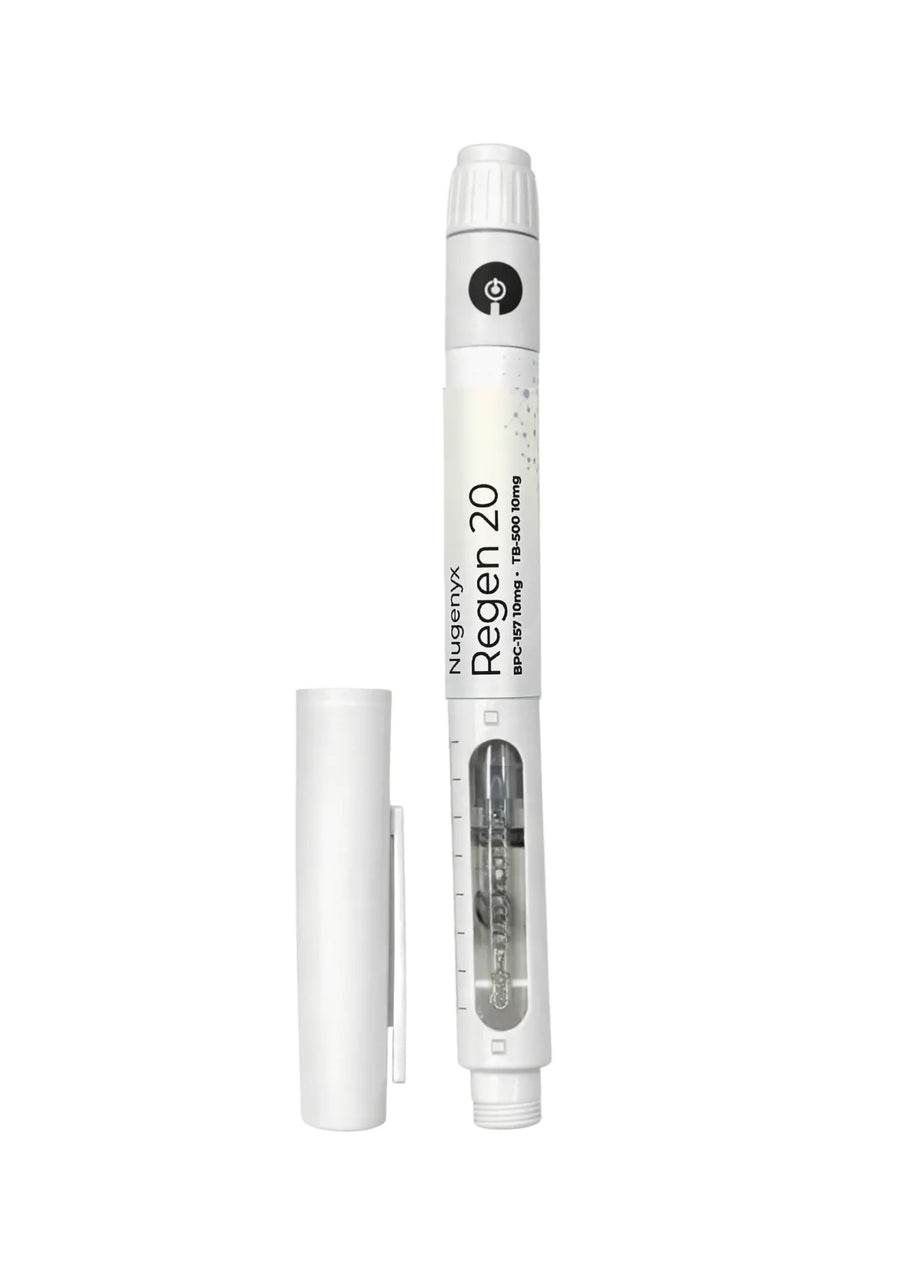
BPC-157 and TB-500 in one pen for repair and recovery-focused research.
£99.00 View product
A copper peptide discussed around skin quality, collagen-support pathways, and repair signalling.
£99.00 View product
Part of the Nugenyx body-composition range. Contact customer care before purchasing.
£229.00 View product
GHK-Cu, BPC-157, TB-500, and KPV in one higher-tier skin and repair-focused format.
£149.00 View productTrust
A quieter proof layer for customers who want to see who already trusts Nugenyx.
Nugenyx is my go-to company for all things wellness and longevity.
Gladiator, TV personality, IFBB pro athlete
The only company I trust with my health and wellness routines.
TEDx speaker, best-selling author
I have seen many peptide companies but Nugenyx is by far the leader.
Senior Associate Royal Society of Medicine
Nugenyx content is educational and informational. It does not provide medical, dosing, diagnostic, treatment, or legal advice. Product suitability and regulatory status can vary by jurisdiction.